
 To say Mass Audubon has been all aflutter over the recent spate of giant swallowtail sightings is putting it mildly. Why are we getting so excited about a butterfly? Well, the giant swallowtail (Papilio cresphontes) was generally considered a rare butterfly in the state, usually spending most of its time to the south and west of Massachusetts.
In fact, according to Butterflies of Massachusetts, between the years 2000 and 2008, there were no giant swallowtails spotted in the Commonwealth. Then a few sightings were reported in 2009 and 2010 and even more in 2011. But this year, there have been many reports from all over the state including Ipswich River (Topsfield), Arcadia (Easthampton and Northampton), Drumlin Farm (Lincoln), Wellfleet Bay (South Wellfleet), and Broad Meadow Brook (Worcester).
Sharon Stichter, editor of the Butterflies of Massachusetts website, confirms that giant swallowtails have been reported in 2012 from just about all areas of Massachusetts. “Last year, we had the first-ever large influx of this southerly species at Sheffield at the beginning of the summer season. Then the offspring (the second brood) radiated out over the state, laying eggs on host plants,” she said.
How could a butterfly that was once rare in Massachusetts be seen in so many places? The short answer: Climate is an important factor in the shifting ranges of many species worldwide, and there is evidence that this is true for Massachusetts, too.
Stichter notes that the unusually mild 2011-2012 winter allowed for many of their chrysalids to survive, resulting in this year’s even larger summer flight. However, she adds, a cold winter could knock the species back to further south, at least temporarily.
It’s not just the giant swallowtail that’s relocating. According to a new study just published by Harvard Forest scientists and the Massachusetts Butterfly Club (including Stichter), there is evidence of “strong shifts in butterfly populations due to climate warming in the state.” The report goes on to say that some species that were once common are showing sharp declines, and southern species, like the giant swallowtail, are showing some of the biggest increases.
Identifying a Giant Swallowtail
While you may find a giant swallowtail around its host plants, which include northern prickly ash and hop tree, you’re most likely to see one feeding from common nectar-producing species such as milkweeds, bee balm, and thistles, among others.
Just don’t let its cousin, the more commonly seen eastern tiger swallowtail, confuse you. Here’s how to tell them apart:
Eastern tiger swallowtail
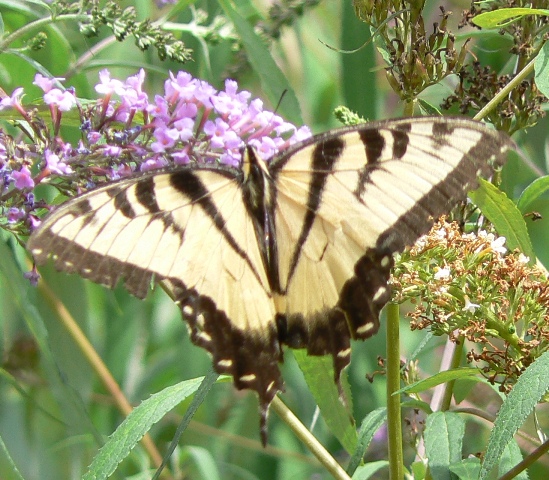
- A tiger swallowtail’s open wings are mostly yellow with thin brown vertical stripes and a brown border across bottom.
- When on a plant, a tiger swallowtail will settle its wings for a few seconds at a time.
Giant swallowtail
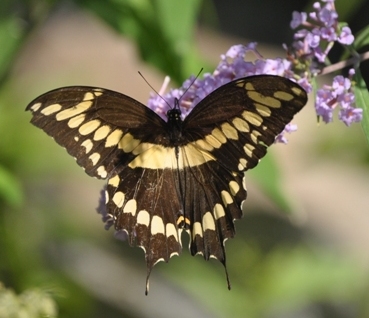
- A giant swallowtail’s open wings are mostly deep brown with a yellow stripe running across to top and lower wings.
- A giant swallowtail typically flutters constantly while nectaring.
- The giant swallowtail has X-like yellow markings near the end of the upper surface of the wing tips and a yellow spot on the tails.
Have you seen a giant swallowtail in Massachusetts? If so, tell us when and where in the comments.