

Author Archives: Hillary T.

About Hillary T.

Where: Mass Audubon Headquarters, Lincoln Who: Massachusetts transplant by way of Florida and New York. Raising two young girls, who she hopes will be budding naturalists Favorite part of the job: Learning something new every day from some of the smartest and most enthusiastic groups of people

Bird Feeder Basics (Plus Summer Feeder Sale)

Thinking about buying a bird feeder but not sure where to start? We can help! Depending on the kind of bird-watching experience you’re looking for and what kinds of birds you want to attract, there’s a feeder for you.

Read on for just a preview of what’s available at the Audubon Shop in Lincoln. And don’t forget: Mass Audubon members can save 20 percent off all feeders, poles, baffles, and feeder accessories during the Shop’s Summer Feeder Sale August 4-19. Not a member? Join today in order to get the sale discount plus all of the other awesome benefits that go along with a Mass Audubon membership.

For the Beginner
The Classic Pole Feeder has everything you need to get started in one box: a feeder that holds five pounds of seed, a three-section pole for mounting the feeder, and a built-in baffle to prevent squirrels from climbing up the pole.

For the Squirrel Averse
Have more squirrels than birds at your feeder? The Squirrel Buster Classic Feeder has a patented design to keep the critters at bay. When a squirrel grabs a hold of the feeder, the outer cage (or “shroud”) lowers to block the feeding ports. What it doesn’t block: a variety of songbirds including, cardinals, nuthatches, chickadees, goldfinches and more.

For the Up-Close Observer
Bring birds right to your window with the Observer Window Feeder. Super easy to use, it attaches to a window with three suction cups. The open “trough” design can hold any type of seed (up to ½ pound) and has a sloped overhang to protect seed from rain or snow. Great for sunflower seed or even mealworms for attracting bluebirds.

For the Hummingbird Lover
The Perky Pet Hummingbird Feeder’s big red and yellow flowers attract the hummingbirds, while its built-in guards on the four feeding ports keeps the bees away.

For the Multitasker
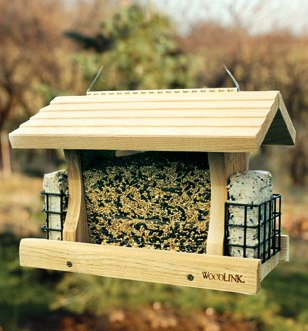
With a large hopper for seed and two suet cages, the Woodlink AT4 Cedar Feeder with Suet Holders (shown) was designed with songbirds and woodpeckers in mind.

Once you decide on a feeder, be sure to check out our Top Five Best Bets for Attracting Birds.

If You Re-Build It…

It’s a story we unfortunately hear all too often. Birds were here, and now some of them are not. This is especially true for Grassland birds (i.e. birds that breed in open fields of 25-plus acres). According to our recent State of the Birds report, these birds are by and large, declining—some of them precipitously so.

But in the case of one Grassland bird, the state-listed Grasshopper Sparrow, we have some exciting news to report! It all started back in 2004, when our Ecological Extension Service (EES) joined forces with the City of Worcester and the Casella Waste Management Company to re-cap the 35-acre Greenwood Street Landfill while maintaining Grasshopper Sparrow habitat.

For those who are unfamiliar with EES, it’s a program through which Mass Audubon shares with conservation partners (land trusts, cities and towns, state and federal agencies) the considerable expertise we’ve developed in managing 34,000 acres including habitat restoration.

The landfill was originally closed and capped in 1986, and the meadow that developed became Grasshopper Sparrow breeding habitat (eight males were observed there during our 1997-2000 statewide Grassland Bird Survey). But when the old landfill cap began to settle, the whole site needed to be re-graded and re-capped. EES proposed a phased approach to re-capping and supervised the 2010 restoration of the first re-capped area with a native grass seed mix.

In regular monitoring visits, our EES team observed Snow Buntings, Eastern Meadowlarks, Bobolinks, and American Kestrels passing through and making occasional use of the site. But they still had their ears peeled for the elusive tik tuk tzeeee of the Grasshopper Sparrow.

This year, as EES staff visited almost weekly, some people wondered whether this bird that had complicated the project was ever at the landfill in the first place. Well they were, and now they’re back!

In early June, two males were observed singing in the restored grassland and defending territory from each other. No females yet, but with these territories featuring lots of little bluestem and dramatic views of Route 146 and the wastewater treatment facility, can they be far behind?

Since this site is considered smaller than the optimal habitat patch size for Grasshopper Sparrows, we hope to continue to monitor the site to assess whether they are successfully breeding. The remaining sections of the landfill will be re-capped and restored in 2013 and 2014. If all goes well, the newly capped landfill will once again provide habitat for Grasshopper Sparrows and other grassland birds.

The Greenwood Street Capping Project is currently an active construction site. Access is restricted to authorized personnel and construction-related activities only. 

Photo via Shawn Carey