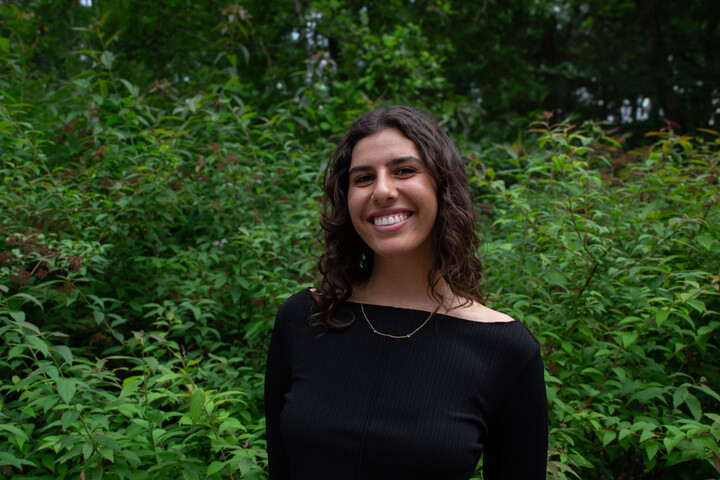
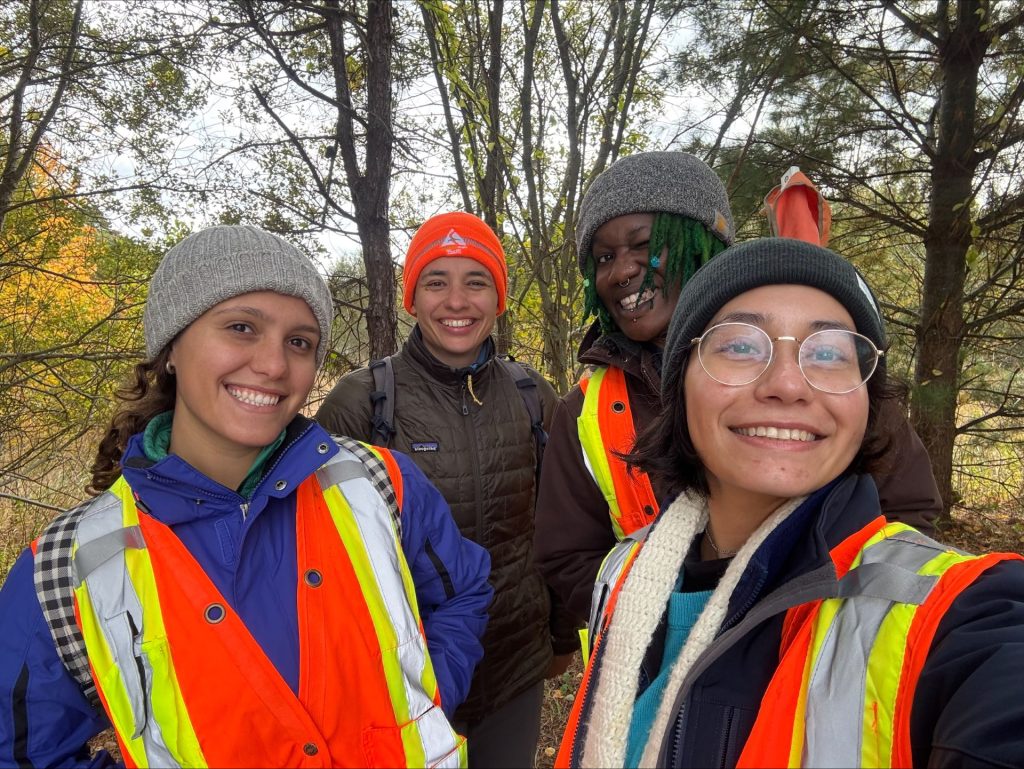
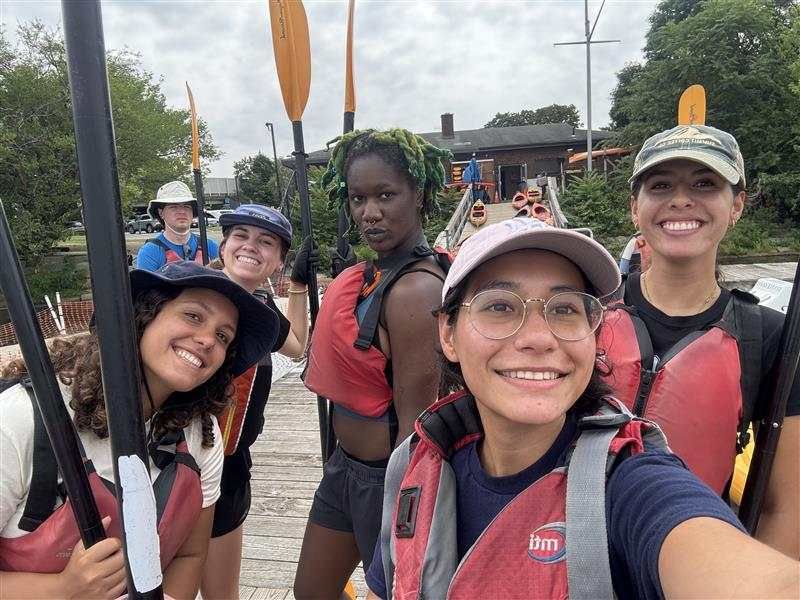
Aiyana Washington working alongside volunteers to remove invasive buckthorn on a trail at Mass Audubon’s Boston Nature Center this summer. Photo by Vincent Noga.
For several years in college, I volunteered as a docent at a biological preserve managed by my university. Though the space housed gorgeous trails and an educational field station less than four miles from campus, a person could only enter the front gate if they navigated a then-outdated website and filled out a request form for a docent to supervise the visit. To better connect students and staff with this vibrant terrain, I conducted a campus-wide survey about barriers to access and found that nearly half of the university’s community was completely unaware of the preserve’s existence, let alone that visitation was a possibility.
In response to my research, I heard from a handful of outraged docents who suggested that increasing visitation to the preserve threatened ongoing conservation. They believed that meeting our stewardship goals meant separating humans from the landscape almost entirely. This limited way of thinking was surprising to me, but it underscored a broader legacy of conservation movements barring people from participation in the outdoors, despite the need for community connection and public education to successfully care for a place and combat environmental degradation. As I worked to bring more of my communities to the preserve, this experience motivated me to dedicate my career to challenging deeply rooted notions of exclusion in green spaces.
When I began my fellowship at Mass Audubon, it was clear that expanding access to nature is core to the organization’s ethos. Mass Audubon manages wildlife sanctuaries across the state to not only protect and restore ecosystems but to also engage people in environmental education and action through public programming, self-guided exploration of trails, and volunteer opportunities. The hands-on work and generosity of volunteers to care for habitat and maintain trails is especially essential to the health of many sanctuaries, and it’s a fantastic entry point into conservation work, offering volunteers a sense of empowerment, community, and connection to New England ecology.
My fellowship position supports the long-term goal of increasing volunteerism at two Mass Audubon sanctuaries that are public-transit accessible, Habitat Education Center (Habitat) in Belmont and the Boston Nature Center (BNC) in Mattapan.
On an average day, I’ll spend my morning with the sanctuary’s property manager and a group of volunteers to work on an activity that furthers the ecological priorities of the sanctuary. In just over two months, I have worked with more than 200 volunteers on a wide range of projects including clearing porcelain berry and nonnative bittersweet from meadows, taking Habitat’s resident goats out to graze on Saturdays, and planting dozens of native shrubs around the BNC’s nature play area. One of my favorite aspects of my role has been lifting the veil on what conservation looks like in practice and showing volunteers how a few hours of work contributes to a larger mission: If we uproot the invasive plants in this meadow, then we’ll begin to see more insects and pollinators. If we bring goats to graze in regions overgrown with bittersweet and buckthorn, then we will promote native plant diversity. If we add native trees to this forest today, then they’ll be likely to survive when scientists start an eventual wetland restoration project.
I’m also helping Habitat and the BNC be more proactive about connecting community members with volunteer opportunities and our sanctuaries more broadly. Through consulting volunteer reports, marketing lists, and the brilliant minds of Mass Audubon education staff and sanctuary directors, I created an outreach plan to build new relationships with community-based organizations, college professors, other nonprofits, and even healthcare institutions.
Volunteer programs like these are one way that Mass Audubon breaks down barriers to engagement with the outdoors and fosters awareness of and investment in environmental conservation. Stewardship of these protected areas is a continuous journey, and the lasting health of this region relies on a multitude of perspectives and skill sets, no shortage of bug spray, and intentional connection with the community members who benefit from our doors, and trails, being open.
This blog was written as a joint effort among the 5 fellows from the Environmental Fellowship Program 2025-2026 cohort: Isabella Acosta-Jimenez (Land Conservation Fellow), Tami Gordon (Nature in the City Fellow), Scarlett Gonzalez (Climate Education Fellow), Hannah McGrath (Advocacy Campaign Fellow), and Tiare Sierra Rivera (Ecological Restoration Fellow).
Coming from different academic disciplines, personal experiences, and geographic backgrounds, we joined Mass Audubon’s Environmental Fellowship Program as a cohort of early-career conservation professionals. We’ve spent the past 14 months learning from one another, building new skills, and contributing to environmental work across Massachusetts. Together, our experiences have been shaped not only by our individual projects, but also by the relationships, mentorship, and shared growth that defined our fellowship journey.
As we come to the end of our fellowship experience, we want to reflect on what we are taking away. The following is a collection of experiences and lessons shaped by our time within our teams and as a cohort.
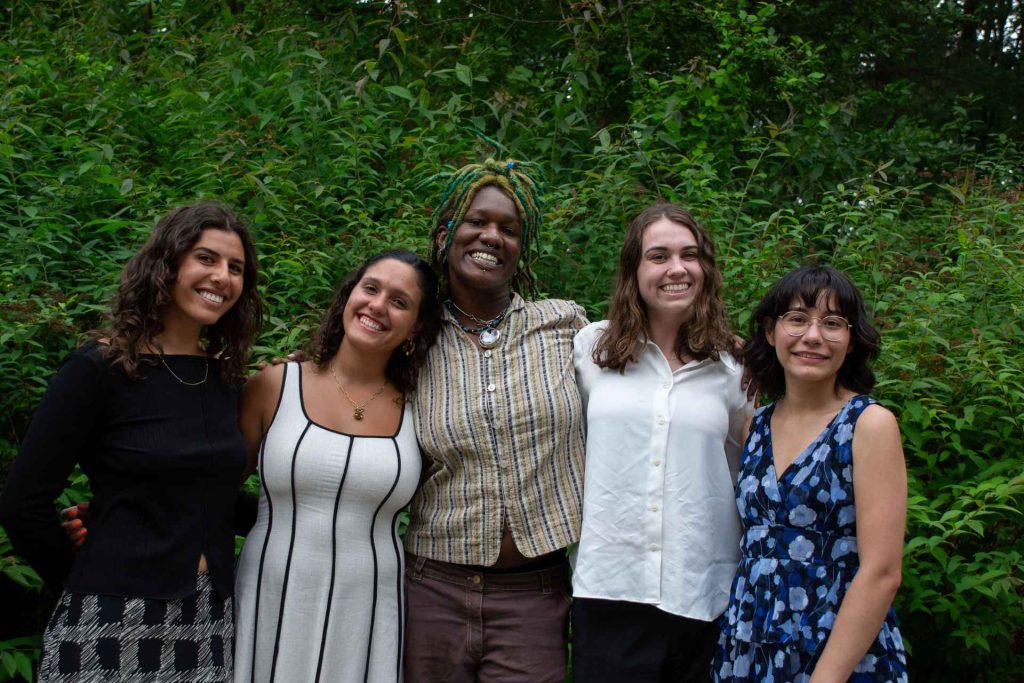
Environmental Fellowship Program Cohort Four. From left: Isabella, Tiare, Tami, Hannah and Scarlett.
Comparison is the thief of joy. Everyone is on their own journeys, so honor the time it takes to go on yours.
I didn’t grow up always knowing I wanted to be an environmentalist. Throughout high school, I intended to pursue software engineering, but in college, I made a drastic shift to environmental science. Entering this new field, I experienced a strong sense of imposter syndrome, surrounded by future doctors, organic chemists, seasoned hikers, and peers who all seemed to have a lifetime of immersive experiences in nature.
Over time, I learned to ground myself by reconnecting with why I chose this path. I remind myself that my skills and experiences are unique, valid, and essential to expanding our understanding of what access to nature can look like.
After graduating college, I was honored with an Environmental Justice Award—something that first-year Boston University Tami could never have imagined. It’s never too late to change directions and find your place. – Tami Gordon
Don’t be afraid to ask or say the obvious thing – it might not be obvious to everyone
Throughout my fellowship, I’ve been in meetings where I assumed everyone else was thinking the same thing I was. While working with a team to coordinate signature collection for Nature for Massachusetts (a ballot initiative dedicated to funding to protect land and water) a colleague encouraged me not to be afraid to say the obvious thing, because what seems obvious to one person may not be obvious to everyone else.
Because my colleagues had more experience, I often felt that anything I noticed or questioned must already be obvious to them. Sometimes that was true, but often it wasn’t. I learned that clearly saying “the obvious thing” actually helped center the conversation and ensure everyone is on the same page. – Hannah McGrath
Know when to ask for help or say “no.”
As an early professional, it’s exciting to say yes to every opportunity, especially if it’s new to you. But as responsibilities grow, so does the need to set boundaries. Asking for support or declining additional work when you’re at capacity is part of being a strong, reliable teammate. – Isabella Acosta-Jimenez
Time management – leaving places earlier, giving yourself time to arrive.
I have a bad habit of being late, and the Fellowship has taught me two important things about what that means in a professional context. First, pretend the arrival time is 10-15 minutes earlier than the actual start time: that will most likely get you there right on time!
Second, know yourself and know your limitations: you know that you are often late and are doing what you can to fix that, but whether you like it or not, you will still be late sometimes – remember it is not the end of the world and there’s no need to beat yourself up too much. – Tiare Sierra Rivera
Say yes to as many opportunities and new experiences as you can.
I don’t consider myself outdoorsy, but this year I found myself waist-deep in a bog searching for turtles with some of Mass Audubon’s ecological restoration team. This experience really pushed me outside of my comfort zone, both physically and intellectually, but I learned a lot about bog ecology, spotted turtles, and Mass Audubon’s efforts to restore this former cranberry bog into a thriving wetland.
When you say yes to as many opportunities as this fellowship (and life) has to offer, you might learn a new skill or, at the very least, have fun. – Scarlett Gonzalez
You’re all going through this together—different journeys, same destination. Lean into the cohort experience as coworkers and potential friends.
My first experience working with Mass Audubon was as a Massachusetts Climate Corps member. One of our first group gatherings was Professional Development Day, where I met the then-EFP cohort (Cohort Three). I remember sitting next to then Climate Education Fellow Uzoma Adichie (Zuzu), chatting, wanting to connect with anyone I could on one of my first days at the organization. That day was two years ago, and now I consider Zuzu one of my closest friends.
One of the best aspects of the cohort experience is the opportunity to build meaningful, lasting relationships, both within your cohort and beyond. Zuzu has been more than just a friend to me—she’s also been a mentor and a constant cheerleader. This experience taught me that your coworkers can become your village if you let them. – Tami Gordon
Advocate for what you want and need!
If you want something, respectfully ask for it – the worst someone could say is no. And if there’s an issue, people might not know about it unless you speak up. – Hannah McGrath
Connect with those in your field and community.
Grab coffee with someone of professional interest at least once a month, whether they work in your field or not. Most people love to feel helpful, so give them a reason to share their advice and/or flag any career opportunities they come across. When people know your name, what you’ve done, and what you are passionate about, they are way more likely to think of you when opportunities arise in the future, even if it’s years after you’ve met. And remember, it’s just as important to connect with those within your workplace, so be friendly and say thank you often. – Scarlett Gonzalez
For larger, long-term projects, break the work into small, manageable milestones over time.
This tip has helped me maintain steady progress, build a sense of accomplishment, and reduce procrastination. I applied this approach while leading my professional project to support camps in implementing an ecological restoration curriculum. Although the project is happening this summer, much of the planning began last fall. Setting incremental milestones, such as drafting lesson materials, coordinating with camp staff, and piloting activities, allowed me to stay on track and avoid last-minute stress. This structure made the project feel more manageable and helped ensure consistent progress toward successful implementation. – Tiare Sierra Rivera
Be bold. Start cold.
When heading into the field on a brisk morning with fewer layers than the weather calls for, trust that you’ll warm up as you go. The same advice applies to starting a new job, working on an unfamiliar project, or navigating a major life transition. You can prepare as much as you’d like, but the only way to learn is by doing. For my professional project, I created a stewardship plan for a conservation property, a task I’d never done before, and it required me to build an entirely new skill set and learn how to read a forest. I met with ecologists and professors to refine my methodology, but in the end, I learned the most during the hours I spent attempting to identify trees and invasive species in the field.
While I still misidentify species, I’ve improved drastically and developed tricks to guide myself. The best way to get better at adapting is to step out of your comfort zone and trust yourself to learn as you go. Each new challenge makes the next one a little less daunting. – Isabella Acosta–Jimenez
Acknowledgements
We sincerely thank our supervisors, Andrea Jerabek, Sam Anderson, Brittany Gutermuth, George Durante, and Megan Gordon, for their mentorship, guidance, and support throughout this experience.
We also extend a massive thank you to the DEIJA Team – Stephen Lin, Taylor Lo, and Nia Keith – for their strong belief in us as fellows and their commitment to strengthening this program.
Finally, we thank Mass Audubon for making this fellowship experience possible.
By Isabella Acosta-Jimenez, Land Conservation Fellow
Students from UMass Amherst Forest Resource Management course gather at Arcadia Wildlife Sanctuary for the Student Research Summit. Isabella Acosta-Jimenez stands at center. Mass Audubon ecologists Christian Marks and Tom Lautzenheiser on the far right.
If you’ve ever looked at property lines on a map, it’s easy to forget that nature doesn’t recognize those boundaries. Deer bound over stone walls. Seeds travel on the wind. Brooks flow downhill. Invasive species spread wherever they can. The invisible lines between two points on the ground are there to show humans who “owns” what, but they mean little to the ecological systems that move freely across them.
I encounter this tension daily in my work protecting priority habitats alongside private landowners, municipalities, and conservation organizations. A stone wall may divide two parcels, one that is part of a wildlife sanctuary with an ecological management plan, and the other privately managed, but buckthorn, beech leaf disease, and deer pressure permeate both. (“Parcels” are individual units of land ownership, and neighboring properties that share a boundary are referred to as abutting.)
We use mechanisms such as conservation restrictions (CR), legal agreements that permanently limit development on privately-owned land, to protect properties neighboring Mass Audubon sanctuaries. These conserved parcels often function as buffers to our sanctuaries, despite often being managed separately or not at all.
When I began my work as the Land Conservation Fellow, I saw protection itself as the goal: secure the land, monitor the boundary, conserve what’s inside. Over time, I’ve come to see how incomplete that approach is. Rather than treating protected parcels as isolated units, we must manage habitats continuously across privately owned protected land and abutting Mass Audubon-owned properties.
My professional project aims to bridge that divide by coordinating stewardship plans across property lines, engaging landowners in shared management strategies, and collaborating with university students and experienced volunteers on field-based projects to assess habitat vulnerabilities across boundaries.
It also extends beyond the field. At a Student Research Summit this May, students from UMass Amherst and Westfield State presented their findings, turning site-specific observations into a broader conversation about landscape-scale stewardship. Collaborators, including students, conservation practitioners, educators, and landowners, came together and, through listening and engagement, we explored methods to evaluate climate resilience, identify and quantify vulnerabilities, and develop adaptive management plans that reflect how ecological systems function on the ground, beyond boundary lines drawn on paper.
Managing by habitat rather than boundary recognizes ecological continuity, and it plays out visibly on the ground. For example, an ash tree grows on a slope above a meandering brook that serves as a parcel boundary. On one side, the land is a sanctuary; on the other, it is privately managed—yet the system functions as one. One year, a regional drought strikes, and the soils dry across the entire slope. Deer move freely between properties, traversing the slope and compacting earth, accelerating erosion on both sides. Roots become exposed, and the tree weakens—along with all the ashes around it. The emerald ash borer arrives, thriving in this landscape-scale stress. Within years, the ash trees are gone—not just from a single parcel, but from the connected system.
During a conversation with a conservation restriction landowner distressed by the loss of ash, beech, and hemlock on her property, I realized how widespread these issues are. When I shared Mass Audubon’s approach—that these species are unlikely to return at scale, and stewardship now requires adaptation rather than restoration—she was stunned. Protection, she realized, was no longer a guarantee of ecosystem stability.
She’s not the only landowner grappling with this reality. In a recent Mass Audubon survey, CR deedholders list their top concerns as invasive species management, trail maintenance, and wildlife habitat stewardship. Many are navigating public access and ecological care without the technical capacity or resources to address the threats that move freely across property lines onto their land. They aren’t asking to relinquish their ownership. They’re asking for partnership.
Large conservation organizations, while often stretched thin, hold a broader regional perspective, along with technical expertise, volunteer networks, and access to funding that individual landowners don’t have on their own. My work sits at that intersection: connecting landowners to support, aligning stewardship across boundaries, and treating ecological care as a shared responsibility rather than an individual burden.
This isn’t defeatism. It’s a recalibration. Rather than insisting on restoration to a fixed past, it asks what can function under changing conditions—and where human intervention can meaningfully slow loss without promising permanence. The Rights of Nature framework challenges us to see the land as a living system with inherent value beyond property.
Stewardship, then, isn’t about control but responsibility to support ecological processes that predate and will outlast us. The work ahead isn’t about drawing harder lines; it’s about caring for what moves across them.
Isabella Acosta-Jimenez (she/her) is originally from New Jersey, where her passion for the outdoors grew from exploring trails and open space. She earned a B.S. in Environmental Studies with honors and a minor in Anthropology from Davidson College in 2024.
At Davidson, Isabella led affinity trips for students of color through Davidson Outdoors and completed an honors capstone using geoarchaeological methods to reconstruct the environmental history of an ancient agricultural site in Cyprus. After graduating, she au pair-ed in Italy, interned at an environmental policy think tank, and served as an instructor at the Cathleen Stone Island Outward Bound School. These experiences have shaped her commitment to scientifically grounded, inclusive, and community-driven conservation.
Outside of work, Isabella enjoys reading, crafting, and exploring new places near and far.
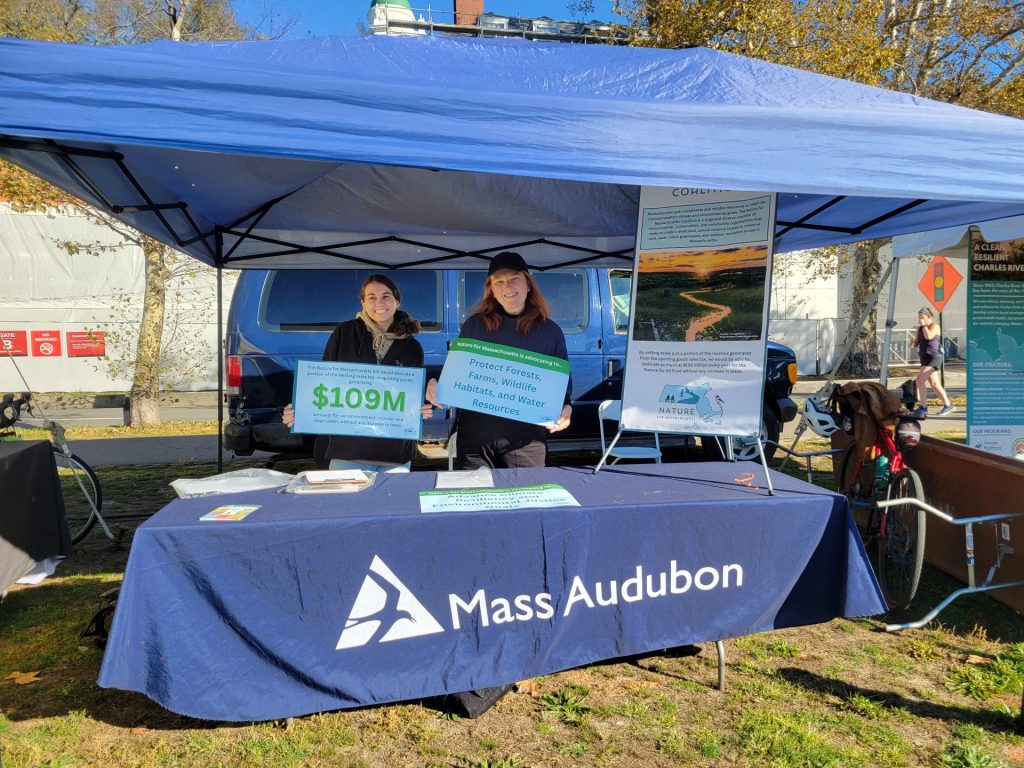
Hannah McGrath left, with Katharine Lange of the Conservation Law Foundation, tabling for the Nature for Massachusetts coalition.
“What will you do when we win?”
That was the question that kicked off the Nature for Massachusetts coalition 2026 planning session, and it stuck with me. Not because I had a profound answer, but because it revealed how policy work can feel both far away and suddenly near. The campaign’s outcome, to dedicate $100 million annually for improving access and protecting nature, could come in November. It seems far off on a calendar, but the amount of work ahead and the pace we need to move at makes it feel like it is rushing toward us.
As my fellowship with the Policy and Advocacy team is progressing, I am gaining a deeper understanding of what makes a policy win possible and why the work moves both slowly and quickly.
Some parts need to happen in a flash: drafting testimony on short timelines, preparing social media language, mobilizing volunteers to act, and responding to breaking policy developments.
Other parts unfold slowly to build a strong foundation for successful policy work: researching potential solar sites, defining our strategy, creating fact sheets on the climate literacy bill our youth programs focus on, and helping coordinate volunteer efforts ahead of the short signature collection period for the Nature for Massachusetts ballot campaign.
Somewhere in the middle of all the fast and slow work, I am developing a clearer sense of what’s needed for a win that benefits everyone. Since this fellowship is based in Mass Audubon’s Diversity and Inclusion department, I’m learning that good, long-lasting policy is shaped by who is at the table and how we work together toward a shared goal. That means asking who’s missing from the room, why, and how we can listen and create space for the voices that are missing, even as the work accelerates. I feel lucky to be working with people across our teams and coalitions who think about that too.
Looking back on that planning session, I still don’t know what I will do when we win. But I understand what it takes to get there, pairing urgency while building a strong base.
Hannah McGrath (she/her) grew up in New Hampshire and got her start in environmental policy as a canvasser in Vermont. She earned her B.A from Hobart and William Smith Colleges as a double major in environmental studies and geoscience, and minored in public policy. She was also a student athlete on the field hockey team and conducted research microplastics in the atmosphere.
Before Mass Audubon, Hannah was an environmental organizer, where she led multiple environmental campaigns. During this time, she was a part of efforts to advocate for renewable energy, expand marine protected areas and ban plastic bags in California by collecting over 11,000 signatures.
By Tiare Sierra Rivera, Ecological Restoration Fellow
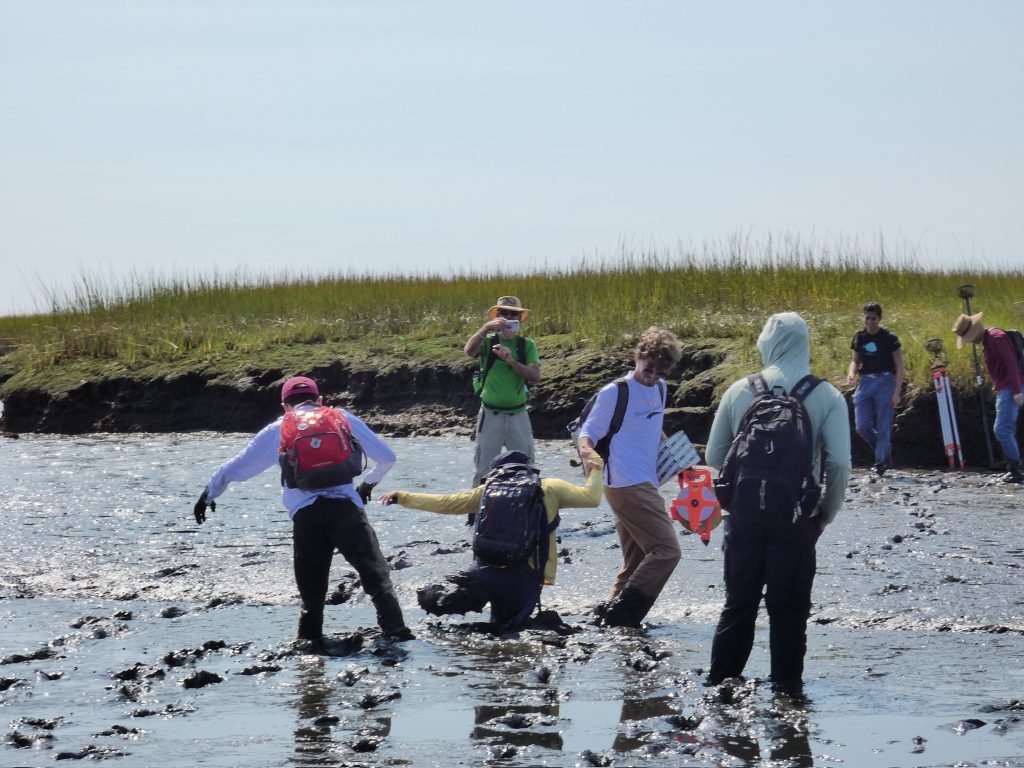
Photo by Isabelle Lam at Plum Island Sound in September 2024. Tiare is pictured in the middle, in yellow, with Prof. Fagherrazzi, in green, taking a picture of the moment.
Not too long ago, I stepped into a salt marsh for the first time. It was a warm and sunny September day, and I was a senior at Boston University taking a class, “Estuaries and Nearshore Systems,” with Professor Sergio Fagherrazzi—a big name in the salt marsh world for his work on marsh morphodynamics during accelerated sea level rise. As part of the class, we headed out to Plum Island Sound, the largest estuarine ecosystem in New England, to collect elevation and sediment data.
It was wonderful: the bright green grasses rolled toward the horizon, the deep blue of the ocean pushed in and out with this quiet-but-powerful rhythm, and then… the smell. A strong, putrid, decomposing peat-meets-salt smell. And yet, paired with the stunning scene and fascinating science at hand, I loved it. By the time I got home, my camera roll had 40 new photos—horseshoe crabs, mud patterns, pickleweed, everything. I had never seen a salt marsh before, since we don’t have them back home in Puerto Rico. Maybe that’s why it felt so magical. But I also couldn’t help thinking: How have I lived in Boston for three years and no one has ever mentioned these places to me?
On the last day of the class, Professor Fagherrazzi awarded me the “Crab Award,” given to the student who had the most fun (and was the most clumsy) on our field work trips out at Plum Island. Fast forward to today, a little over two years later, and the biggest project of my fellowship with Mass Audubon’s Ecological Restoration team has been, fittingly, the Salt Marsh Framework.
Mass Audubon’s Senior Coastal Ecologist Sara Grady has been dreaming about this project since 2024. When I joined the Ecological Restoration team in June 2025, she told me about her idea of mapping all salt marshes in the state and gathering multiple datasets to visualize information on the present and future of salt marshes in Massachusetts. She then hoped to use that data to roll out statewide management and restoration recommendations to local governments, organizations, and scientists interested in restoration. 305 hours of work later, from October 2025 to April 2026, the Salt Marsh Framework is now doing just that.
Today, the Salt Marsh Framework is a GIS-based model that scores marshes across three dimensions: Condition (looking at vegetation health and surrounding land use); Trajectory (accounting for tidal position, elevation gain, marsh-edge exposure); and Migration (assessing potential opportunities for salt marsh landward movement as sea level rises). These scores connect directly to restoration and management actions, helping users understand both the urgency and the restoration potential. The framework includes extra “lenses” like marsh size, blue carbon value, and bird habitat importance so anyone—from academics and students to researchers and consultants to conservationists and other scientists—can tailor decisions to their ecological goals. The version 1 Map Viewer product is now available for anyone curious about the state of Massachusetts salt marshes.
Working on this project opened a huge door for me: I was recently accepted into the University of Rhode Island Graduate School of Oceanography to pursue a Master of Science in Marine Geology. Starting in September, I’ll be researching salt marsh resilience and migration across Northeast National Parks, from Assateague Island in Virginia all the way up to Acadia in Maine. Whether it is analyzing data or getting muddy out in the salt marsh, I’m excited for another opportunity to get to know these ecosystems a little better—both for my own pleasure and for a future full of healthy salt marshes.
Tiare Sierra Rivera (she/her) grew up in Puerto Rico. She graduated from Boston University with a B.A. in Earth and Environmental Science, concentrating in GIS and remote sensing, and minoring in marine science. While at BU, she was a student-athlete on the sailing team, earning MVP honors two years in a row.
Tiare’s environmental journey includes two summer internships in climate resiliency and environmental permitting, as well as a transformative summer experience conducting scientific diving research in Mozambique. During the academic year, she taught an accredited sailing course to fellow college students and served as a teaching assistant for an introductory environmental science class.
Tami Gordon, Nature in the City Fellow, at Mass Audubon’s Boston Nature Center in Mattapan.
As the Nature in the City (NITC) Fellow with Mass Audubon, I recently attended the Hope Summit in Charleston, South Carolina, a gathering that brought coastal and inland communities together to explore how land, water, and people are interconnected. Mornings were filled with workshops led by city planners, non-profit founders, early-career and seasoned professionals. Our afternoons were spent walking the city, learning through observation and experience. (Who knew that falling down the stairs on your first day is a great way to get people to talk to you?)
The Summit’s focus on community resilience, climate preparedness, and equity reflects the foundation of the NITC program: meaningful engagement, co-governance, and place-based solutions. The central theme of hope reminded me that climate work is most powerful when it is rooted in collective stories and communal, hands-on experiences.
A workshop titled Re-Story-Ation emphasized “Experience > Explanation,” reminding us that people are moved less by data than by what they can feel, touch, and witness firsthand. Effective environmental storytelling invites emotional and embodied understanding, making space for community voices that hold both memory and expertise.
This raised key questions: Where does local knowledge—like shared memories of unofficial community landmarks or a farmer’s multi-generational expertise—fit alongside technical expertise, like standardized historical and landmark processes and agricultural policy? And in the American South especially, how does cultural incompetency limit ecological understanding?
Inside the Charleston Museum, a painting of a Confederate flag hung over our conference room. Romanticizing slavery like this implies that some lives (and some lands) hold less value, a hierarchy that still shapes environmental inequities today. When land is treated as expendable, the people closest to it (often Black and Indigenous communities) are treated as expendable too.
At the Summit, I learned that across the South, many plantations have been converted into wildlife sanctuaries. We explored how this sort of interpretation of historical land use often prioritizes scenery over the lives of enslaved people who shaped those landscapes. This is why climate justice cannot be separated from racial justice; cultural competency in resilience planning requires acknowledging historical harm, and development—even towards something “good” like a wildlife sanctuary—that ignores community history, like slavery, risks repeating cycles of exclusion.
My time in South Carolina affirmed that my professional project—a key part of the Early Career Fellowship experience—must center cultural inclusivity, belonging, and place activation. Storytelling and embodied practices like dance, humor, ritual, being with the land are all powerful tools that help us face climate grief and reconnect with one another.
People are not the problem—disconnection is. And reconnection begins with stories that make change feel possible. My upcoming study will discern how to embed cultural development into place-making by studying the lived experiences community members have with open spaces. Through this work, I hope to further the ways we all show up for racial justice, for our neighborhoods, and for the urban landscapes we share, so our cities can become places where everyone knows they belong.
Tami Gordon (they/them/theirs) is the Nature in the City Fellow for Cohort 4 (2025-2026). Tami works with the Nature in the City program staff and provides support to both the Boston Tree Alliance and Broadmeadow Brook. A recent graduate from Boston University’s Earth and Environmental Sciences program, Tami has been a lover of the environment since they were a child growing up with the stories of their Jamaican and Trinidadian household. When they’re not at work, you can find them making music, birding, or writing.
By Isabella Acosta-Jimenez, Land Conservation Fellow
Isabella Acosta-Jimenez, Land Conservation Fellow.
I used to think land protection was simple. At its core, I thought it meant safeguarding forests and wetlands from development. “Protection in perpetuity” sounded abstract until I joined Mass Audubon as this year’s Land Conservation Fellow, and I realized all that goes into it. Due diligence, legal agreements, and partnerships only lay the foundation, but conservation doesn’t end there. It’s a puzzle.
It starts with people like me piecing together the “border” of the bigger land conservation puzzle—playing land detective and searching for opportunities to connect open space, parcel by parcel, story by story. Logistics and an interdisciplinary blend of fundraising, education, conservation science, and more all work in harmony to ensure land remains conserved and stewarded for generations.
One way I do this is through participating in the Nashua Land and Waters Regional Conservation Partnership (RCP)—a powerhouse group of women who meet monthly to talk strategy. This partnership reinforces the idea that conservation is a collaborative and deeply community-based endeavor: conservation cannot happen if people don’t care. We ask: What does the local community want to protect? How do we meet landowners where they are, balancing their expectations while ensuring their land is conserved? And once it’s protected, how does the community want to engage with it?
Through Mass Audubon’s 30×30 Catalyst Fund, seeded by MathWorks, we help smaller land trusts launch projects that reflect these priorities. Mass Audubon brings funding, expertise, and a spirit of collaboration to the table as we support organizations that work with community leaders and landowners to identify and elevate significant conservation opportunities.
Recently, I visited a potential Conservation Restriction (CR) site in Springfield, an urban five-acre parcel that, frankly, was a bit grim: litter everywhere, blankets of invasive plants, spotted lanternflies sucking life out of trees, and signs of abandoned unhoused encampments. For the visit, folks came together from all corners: land protection specialists, the director of Mass Audubon’s Nature in the City program, city officials, and educators from both Mass Audubon and the National Park Service.
Beforehand, I created maps to help us situate ourselves and understand the site’s larger context. As we walked the property and the surrounding area, we began reading the land and imagining its next chapter. What if the site could connect a nearby school to the adjacent protected space, allowing students to walk from their classrooms into greenspace and a restored wetland, where they could learn with and from nature? It’s just five acres, but it’s another puzzle piece—one that helps stitch together fragmented open space in Springfield.
Land conservation often comes down to legal documents, title reviews, and GIS layouts. But it’s also standing in the field, imagining what nature could be and the impact that a relationship with nature could have. This cannot happen without site visits like the one in Springfield, which unite community voices on the ground and carve a path for land protection, management and engagement, once the land is secured.
Conservation means aligning priorities, securing funding, and weaving partnerships to work towards a completed puzzle: finalized land projects. Every deed I review and every site I visit in this role reminds me that conservation is a puzzle—and I’m proud to be part of the team putting the pieces together.
Isabella Acosta-Jimenez (she/her) is originally from New Jersey, where her passion for the outdoors grew from exploring trails and open space. She earned a B.S. in Environmental Studies with honors and a minor in Anthropology from Davidson College in 2024.
In college, Isabella led affinity trips for students of color as part of Davidson Outdoors and completed an honors capstone applying geoarchaeological methods to reconstruct the environmental history of an ancient agricultural site in Cyprus. After graduating, she worked as an au pair in Italy, as an intern at an environmental policy think tank, and as an instructor at the Cathleen Stone Island Outward Bound School. These experiences have shaped her commitment to scientifically grounded, inclusive, and community-driven conservation.
Outside of work, Isabella enjoys reading and exploring new places, near and far.
By Tiare Sierra Rivera, Ecological Restoration Fellow
From left: Tiare Sierra Rivera, Emily Jones, Tami Gordon and Scarlett González participate from a day of field work at a cranberry bog restoration site.
If I had to choose one word to describe the thread that runs through my career journey in environmental science, it would be “fascination.” To me, fascination is that feeling of being so wowed by something that you’re moved to take action on it.
It is a force that has guided my childhood wonder into a professional purpose. My parents are both sailors, and growing up, learning about sailing was a fascinating experience. We would sail along the coast of Puerto Rico and beyond, all the way up to the US and British Virgin Islands. I wondered how the wind powered our boat, and what the birds, fish, and wildlife I saw were doing. Looking at the coast from the perspective of the ocean made me curious about how much impact the oceans had on the land. Every day was different, but I noticed patterns and made connections based on where and when we were sailing. I didn’t know it yet, but all of these were seeds—fascination moments—that led me to where I am today.
My love of fascination became more apparent in college. As a freshman at Boston University, I was introduced to the mapping and data technology of geographic information systems, GIS, and remote sensing, the science of obtaining information from an area or object at a distance, from aircrafts or satellites. Soon, whenever I wondered “what? when? how? why?” I could pull out my computer and explore it using GIS. These skills allowed me to answer questions that fascinated me, such as “how did mangrove forests in Puerto Rico spatially change after hurricanes?” and “how has urban space increased in tourism hotspots in Puerto Rico over the last 20 years?”
Then came the summer before my junior year, when I was a coastal resiliency intern at Woods Hole Group, an environmental engineering company that provides services for coastal, ocean, wetland and terrestrial environments. On the very first day, I heard for the first time the term “marsh migration”: the natural process by which saltmarshes expand inland in response to changes in environmental conditions, such as rising sea levels. It was another fascination moment, one that shifted my focus and led me toward developing a professional project looking at salt marsh migration corridors across Cape Cod, using GIS.
My fascinating experiences with GIS, remote sensing and coastal wetlands led me to find the Ecological Restoration Fellowship opportunity as I was applying for jobs after college. When I applied to the Mass Audubon Environmental Fellowship Program, I felt that same spark of excitement. I knew this opportunity would bring more moments of discovery and more chances to be amazed—and it has. Working with the Ecological Restoration team here at Mass Audubon, I’ve spent a lot of time learning about cranberry bog restoration, the process of returning retired cranberry farms, often built atop wetlands, to their natural state by removing agricultural modifications like ditches, dams, and sand, and allowing native ecosystems to recover.
It fascinated me how, after a cranberry bog is turned barren using heavy machinery, no seeding or planting is needed in historic wetlands for native vegetation to regrow. It’s a reminder that the earth is magical, and that sometimes, the best thing we can do is step back and watch nature heal itself.
Now, I wake up every morning driven by the same fascination that first took hold of me as a kid staring out at the coastline from a sailboat. That sense of wonder—of watching nature work in patterns, of asking “why?” and “how?”—fuels my work in ecological restoration today. It’s those moments of awe that keep me going and curious about what’s next.
Tiare Sierra Rivera (she/her) grew up in Puerto Rico. She recently graduated from Boston University with a B.A. in Earth and Environmental Science, concentrating in GIS and remote sensing, and minoring in marine science. While at BU, she was a student-athlete on the sailing team, earning MVP honors two years in a row.
Tiare’s environmental journey includes two summer internships in climate resiliency and environmental permitting, as well as a transformative summer experience conducting scientific diving research in Mozambique. During the academic year, she taught an accredited sailing course to fellow college students and served as a teaching assistant for an introductory environmental science class.
The Fellows preparing to kayak with the Mystic River Watershed Association. Left to right: Tiare Sierra Rivera, Hannah McGrath, Tami Gordon, Scarlett Gonzales, Isabella Acosta-Jimenez.
During a fellows’ field trip with the Mystic River Watershed Association, I stared into a vial of river water as the color shifted from clear to purple to clear again, before sheepishly asking, “So…what does this actually tell us?”
The educator kindly explained that we were measuring the amount of dissolved oxygen in the water, and our sample indicated that the river had plenty for the fish and plant life to thrive that day.
I felt a little embarrassed that I didn’t understand the Winkler Titration Method as well as my peers; my past work in environmental policy has often left me one of the most knowledgeable people in a room, and it’s been challenging, in my role as Mass Audubon’s Climate Education Fellow, to find myself in a climate-oriented environment and not know all the answers.
But asking the “obvious” question is not a weakness. My job, I’ve learned, is less about having all the answers and more about modeling curiosity for the youth leaders that I support.
Much of my time as the Climate Education Fellow is spent supporting Mass Audubon’s Youth Climate Leaders Program (YCLP), a program that empowers youth activists to lead and drive climate action across the state. Since starting in June, I’ve worked to strengthen the program’s structure—meeting with youth leaders, coordinating with coalition partners, and identifying gaps in onboarding and mentorship. I am also currently supporting the YCLP’s annual retreat, where youth leaders gather to share ideas, ask questions, and connect with one another. At this retreat, I’ll be leading a workshop on climate policy and advocacy, where interested youth leaders can begin exploring climate questions of their own.
Recently, alongside the Massachusetts Youth Climate Coalition, YCLP leaders spearheaded H.560/S.391: An Act Implementing Elementary and Secondary Interdisciplinary Climate Literacy Education. I’m excited to help prepare them for an upcoming hearing and lobby day at the State House, drawing on my policy background to ensure their voices land powerfully. (Download this fact sheet to read more about the bill.)
Outside of my day-to-day tasks within the Education Department, I’m challenging myself to interact with nature in ways that are new for me. Before this fellowship, nature was something I appreciated from afar; I have never been the type to dig in the dirt, poke around tidepools, or pick up periwinkles—now, that’s changing. As I help guide the questions that youth climate leaders are asking, I’m finding new questions myself.
And while I may not always know the answers, I’m learning that the lesson is in the asking.
Scarlett Gonzalez (she/her) is from rural Indiana, where her interest in environmental justice began through learning how the animal agriculture industry and labor rights intersect with environmentalism. In 2023, she earned a Bachelor of Arts in Public Policy and Environmental Studies from New York University.
In college, Scarlett successfully encouraged her university to fully divest from fossil fuels as a member of the Sunrise Movement NYU chapter. She then worked with Rep. Raúl Grijalva and the House Natural Resources Committee as a Congressional Hispanic Caucus Institute Public Policy Fellow.
In her free time, Scarlett enjoys kayaking, journaling, and visiting new coffee shops.