

By Isabella Acosta-Jimenez, Land Conservation Fellow
If you’ve ever looked at property lines on a map, it’s easy to forget that nature doesn’t recognize those boundaries. Deer bound over stone walls. Seeds travel on the wind. Brooks flow downhill. Invasive species spread wherever they can. The invisible lines between two points on the ground are there to show humans who “owns” what, but they mean little to the ecological systems that move freely across them.
I encounter this tension daily in my work protecting priority habitats alongside private landowners, municipalities, and conservation organizations. A stone wall may divide two parcels, one that is part of a wildlife sanctuary with an ecological management plan, and the other privately managed, but buckthorn, beech leaf disease, and deer pressure permeate both. (“Parcels” are individual units of land ownership, and neighboring properties that share a boundary are referred to as abutting.)
We use mechanisms such as conservation restrictions (CR), legal agreements that permanently limit development on privately-owned land, to protect properties neighboring Mass Audubon sanctuaries. These conserved parcels often function as buffers to our sanctuaries, despite often being managed separately or not at all.
When I began my work as the Land Conservation Fellow, I saw protection itself as the goal: secure the land, monitor the boundary, conserve what’s inside. Over time, I’ve come to see how incomplete that approach is. Rather than treating protected parcels as isolated units, we must manage habitats continuously across privately owned protected land and abutting Mass Audubon-owned properties.
My professional project aims to bridge that divide by coordinating stewardship plans across property lines, engaging landowners in shared management strategies, and collaborating with university students and experienced volunteers on field-based projects to assess habitat vulnerabilities across boundaries.
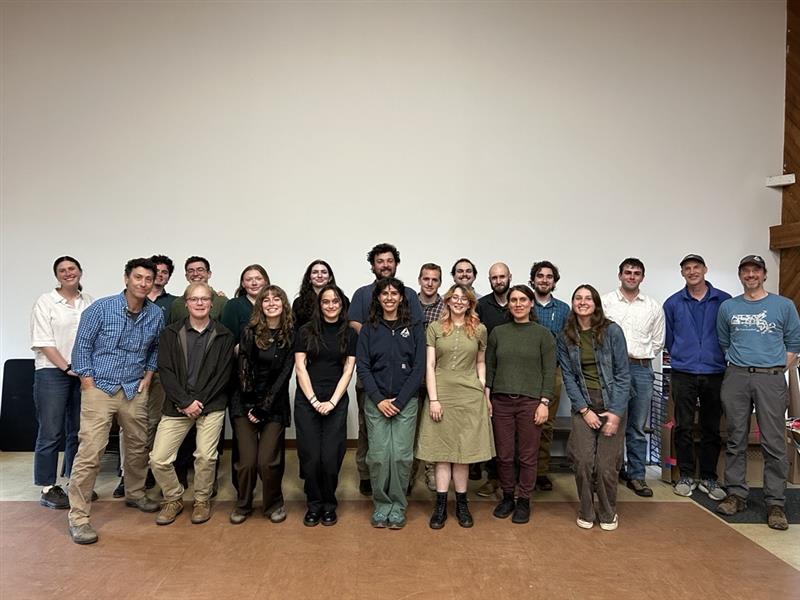
It also extends beyond the field. At a Student Research Summit this May, students from UMass Amherst and Westfield State presented their findings, turning site-specific observations into a broader conversation about landscape-scale stewardship. Collaborators, including students, conservation practitioners, educators, and landowners, came together and, through listening and engagement, we explored methods to evaluate climate resilience, identify and quantify vulnerabilities, and develop adaptive management plans that reflect how ecological systems function on the ground, beyond boundary lines drawn on paper.
Managing by habitat rather than boundary recognizes ecological continuity, and it plays out visibly on the ground. For example, an ash tree grows on a slope above a meandering brook that serves as a parcel boundary. On one side, the land is a sanctuary; on the other, it is privately managed—yet the system functions as one. One year, a regional drought strikes, and the soils dry across the entire slope. Deer move freely between properties, traversing the slope and compacting earth, accelerating erosion on both sides. Roots become exposed, and the tree weakens—along with all the ashes around it. The emerald ash borer arrives, thriving in this landscape-scale stress. Within years, the ash trees are gone—not just from a single parcel, but from the connected system.
During a conversation with a conservation restriction landowner distressed by the loss of ash, beech, and hemlock on her property, I realized how widespread these issues are. When I shared Mass Audubon’s approach—that these species are unlikely to return at scale, and stewardship now requires adaptation rather than restoration—she was stunned. Protection, she realized, was no longer a guarantee of ecosystem stability.
She’s not the only landowner grappling with this reality. In a recent Mass Audubon survey, CR deedholders list their top concerns as invasive species management, trail maintenance, and wildlife habitat stewardship. Many are navigating public access and ecological care without the technical capacity or resources to address the threats that move freely across property lines onto their land. They aren’t asking to relinquish their ownership. They’re asking for partnership.
Large conservation organizations, while often stretched thin, hold a broader regional perspective, along with technical expertise, volunteer networks, and access to funding that individual landowners don’t have on their own. My work sits at that intersection: connecting landowners to support, aligning stewardship across boundaries, and treating ecological care as a shared responsibility rather than an individual burden.
This isn’t defeatism. It’s a recalibration. Rather than insisting on restoration to a fixed past, it asks what can function under changing conditions—and where human intervention can meaningfully slow loss without promising permanence. The Rights of Nature framework challenges us to see the land as a living system with inherent value beyond property.
Stewardship, then, isn’t about control but responsibility to support ecological processes that predate and will outlast us. The work ahead isn’t about drawing harder lines; it’s about caring for what moves across them.
Isabella Acosta-Jimenez (she/her) is originally from New Jersey, where her passion for the outdoors grew from exploring trails and open space. She earned a B.S. in Environmental Studies with honors and a minor in Anthropology from Davidson College in 2024.
At Davidson, Isabella led affinity trips for students of color through Davidson Outdoors and completed an honors capstone using geoarchaeological methods to reconstruct the environmental history of an ancient agricultural site in Cyprus. After graduating, she au pair-ed in Italy, interned at an environmental policy think tank, and served as an instructor at the Cathleen Stone Island Outward Bound School. These experiences have shaped her commitment to scientifically grounded, inclusive, and community-driven conservation.
Outside of work, Isabella enjoys reading, crafting, and exploring new places near and far.