

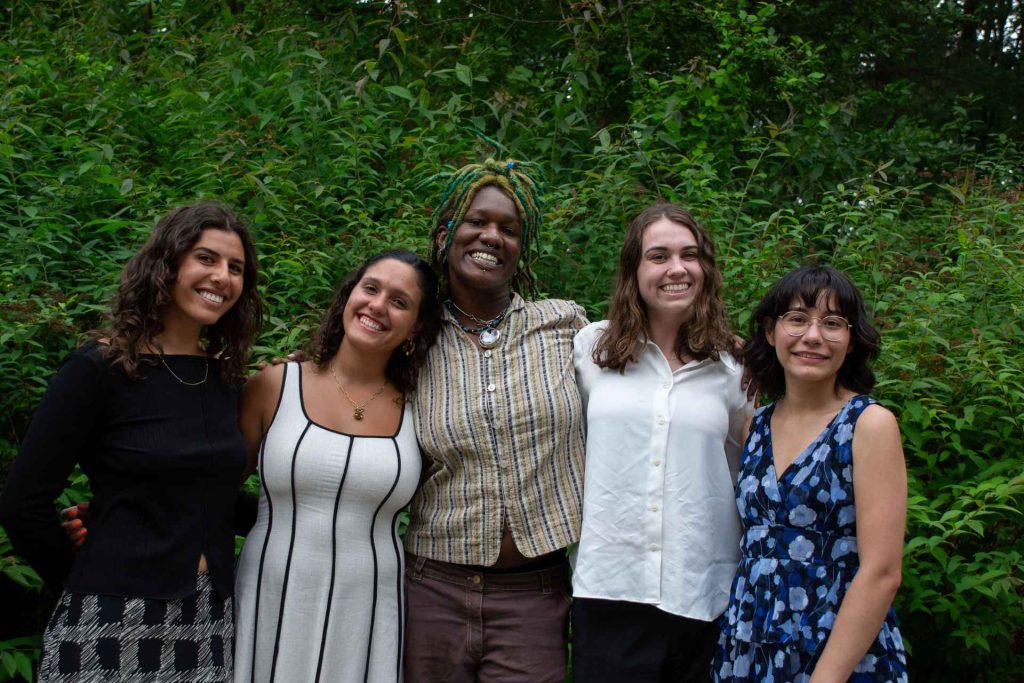
This blog was written as a joint effort among the 5 fellows from the Environmental Fellowship Program 2025-2026 cohort: Isabella Acosta-Jimenez (Land Conservation Fellow), Tami Gordon (Nature in the City Fellow), Scarlett Gonzalez (Climate Education Fellow), Hannah McGrath (Advocacy Campaign Fellow), and Tiare Sierra Rivera (Ecological Restoration Fellow).
Coming from different academic disciplines, personal experiences, and geographic backgrounds, we joined Mass Audubon’s Environmental Fellowship Program as a cohort of early-career conservation professionals. We’ve spent the past 14 months learning from one another, building new skills, and contributing to environmental work across Massachusetts. Together, our experiences have been shaped not only by our individual projects, but also by the relationships, mentorship, and shared growth that defined our fellowship journey.
As we come to the end of our fellowship experience, we want to reflect on what we are taking away. The following is a collection of experiences and lessons shaped by our time within our teams and as a cohort.
- Comparison is the thief of joy. Everyone is on their own journeys, so honor the time it takes to go on yours.
I didn’t grow up always knowing I wanted to be an environmentalist. Throughout high school, I intended to pursue software engineering, but in college, I made a drastic shift to environmental science. Entering this new field, I experienced a strong sense of imposter syndrome, surrounded by future doctors, organic chemists, seasoned hikers, and peers who all seemed to have a lifetime of immersive experiences in nature.
Over time, I learned to ground myself by reconnecting with why I chose this path. I remind myself that my skills and experiences are unique, valid, and essential to expanding our understanding of what access to nature can look like.
After graduating college, I was honored with an Environmental Justice Award—something that first-year Boston University Tami could never have imagined. It’s never too late to change directions and find your place. – Tami Gordon
- Don’t be afraid to ask or say the obvious thing – it might not be obvious to everyone
Throughout my fellowship, I’ve been in meetings where I assumed everyone else was thinking the same thing I was. While working with a team to coordinate signature collection for Nature for Massachusetts (a ballot initiative dedicated to funding to protect land and water) a colleague encouraged me not to be afraid to say the obvious thing, because what seems obvious to one person may not be obvious to everyone else.
Because my colleagues had more experience, I often felt that anything I noticed or questioned must already be obvious to them. Sometimes that was true, but often it wasn’t. I learned that clearly saying “the obvious thing” actually helped center the conversation and ensure everyone is on the same page. – Hannah McGrath
- Know when to ask for help or say “no.”
As an early professional, it’s exciting to say yes to every opportunity, especially if it’s new to you. But as responsibilities grow, so does the need to set boundaries. Asking for support or declining additional work when you’re at capacity is part of being a strong, reliable teammate. – Isabella Acosta-Jimenez
- Time management – leaving places earlier, giving yourself time to arrive.
I have a bad habit of being late, and the Fellowship has taught me two important things about what that means in a professional context. First, pretend the arrival time is 10-15 minutes earlier than the actual start time: that will most likely get you there right on time!
Second, know yourself and know your limitations: you know that you are often late and are doing what you can to fix that, but whether you like it or not, you will still be late sometimes – remember it is not the end of the world and there’s no need to beat yourself up too much. – Tiare Sierra Rivera
- Say yes to as many opportunities and new experiences as you can.
I don’t consider myself outdoorsy, but this year I found myself waist-deep in a bog searching for turtles with some of Mass Audubon’s ecological restoration team. This experience really pushed me outside of my comfort zone, both physically and intellectually, but I learned a lot about bog ecology, spotted turtles, and Mass Audubon’s efforts to restore this former cranberry bog into a thriving wetland.
When you say yes to as many opportunities as this fellowship (and life) has to offer, you might learn a new skill or, at the very least, have fun. – Scarlett Gonzalez
- You’re all going through this together—different journeys, same destination. Lean into the cohort experience as coworkers and potential friends.
My first experience working with Mass Audubon was as a Massachusetts Climate Corps member. One of our first group gatherings was Professional Development Day, where I met the then-EFP cohort (Cohort Three). I remember sitting next to then Climate Education Fellow Uzoma Adichie (Zuzu), chatting, wanting to connect with anyone I could on one of my first days at the organization. That day was two years ago, and now I consider Zuzu one of my closest friends.
One of the best aspects of the cohort experience is the opportunity to build meaningful, lasting relationships, both within your cohort and beyond. Zuzu has been more than just a friend to me—she’s also been a mentor and a constant cheerleader. This experience taught me that your coworkers can become your village if you let them. – Tami Gordon
- Advocate for what you want and need!
If you want something, respectfully ask for it – the worst someone could say is no. And if there’s an issue, people might not know about it unless you speak up. – Hannah McGrath
- Connect with those in your field and community.
Grab coffee with someone of professional interest at least once a month, whether they work in your field or not. Most people love to feel helpful, so give them a reason to share their advice and/or flag any career opportunities they come across. When people know your name, what you’ve done, and what you are passionate about, they are way more likely to think of you when opportunities arise in the future, even if it’s years after you’ve met. And remember, it’s just as important to connect with those within your workplace, so be friendly and say thank you often. – Scarlett Gonzalez
- For larger, long-term projects, break the work into small, manageable milestones over time.
This tip has helped me maintain steady progress, build a sense of accomplishment, and reduce procrastination. I applied this approach while leading my professional project to support camps in implementing an ecological restoration curriculum. Although the project is happening this summer, much of the planning began last fall. Setting incremental milestones, such as drafting lesson materials, coordinating with camp staff, and piloting activities, allowed me to stay on track and avoid last-minute stress. This structure made the project feel more manageable and helped ensure consistent progress toward successful implementation. – Tiare Sierra Rivera
- Be bold. Start cold.
When heading into the field on a brisk morning with fewer layers than the weather calls for, trust that you’ll warm up as you go. The same advice applies to starting a new job, working on an unfamiliar project, or navigating a major life transition. You can prepare as much as you’d like, but the only way to learn is by doing. For my professional project, I created a stewardship plan for a conservation property, a task I’d never done before, and it required me to build an entirely new skill set and learn how to read a forest. I met with ecologists and professors to refine my methodology, but in the end, I learned the most during the hours I spent attempting to identify trees and invasive species in the field.
While I still misidentify species, I’ve improved drastically and developed tricks to guide myself. The best way to get better at adapting is to step out of your comfort zone and trust yourself to learn as you go. Each new challenge makes the next one a little less daunting. – Isabella Acosta–Jimenez
Acknowledgements
We sincerely thank our supervisors, Andrea Jerabek, Sam Anderson, Brittany Gutermuth, George Durante, and Megan Gordon, for their mentorship, guidance, and support throughout this experience.
We also extend a massive thank you to the DEIJA Team – Stephen Lin, Taylor Lo, and Nia Keith – for their strong belief in us as fellows and their commitment to strengthening this program.
Finally, we thank Mass Audubon for making this fellowship experience possible.